Nucleic Acids Research: The Multimerization Pathway of the Glucocorticoid Receptor
A study recently published in Nucleic Acids Research uncovers how the glucocorticoid receptor (GR) forms multimeric clusters, a key process for its normal cellular function and for the development of improved therapies for inflammatory and autoimmune diseases.
This multidisciplinary research is the result of a broad collaboration involving teams led by Gordon L. Hager (U.S. National Institutes of Health), and Jaime Rubio Martínez and M.ª Nuria Peralta Moreno from the Faculty of Chemistry and the Institute of Theoretical and Computational Chemistry (IQTC-UB). The project was coordinated by Eva Estébanez-Perpiñá, from the Faculty of Biology and the Institute of Biomedicine (IBUB) of the University of Barcelona, and also included contributions from researchers at IRB Barcelona, ICVV-CSIC, IBV-CSIC, and the University of Buenos Aires.
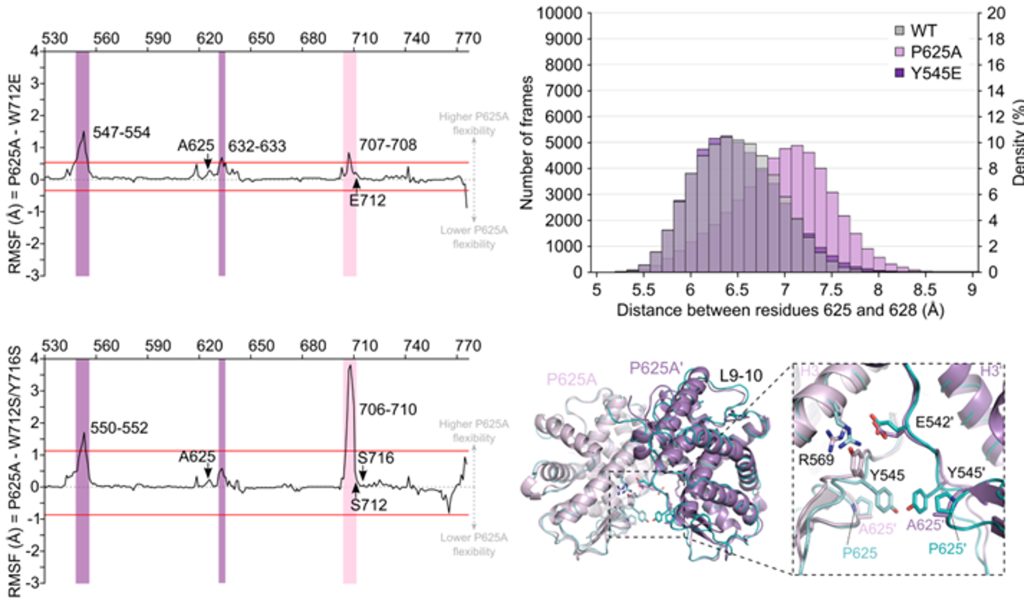
The theoretical team at IQTC-UB explored the dynamics of GR multimerization through Molecular Dynamics simulations. Their work helped support a new structural model for the multidomain receptor and revealed how specific mutations—such as Tyr545Glu, Pro625Ala, Trp712Glu, and the double mutant Trp712Ser / Tyr716Ser—affect receptor dimerization. The study also emphasizes the crucial role of Arg569, providing insight into why the Arg569Gln mutation is associated with reversible glucocorticoid resistance.
You can read the full article:
https://academic.oup.com/nar/article/53/19/gkaf1003/8294360